Share
Facebook
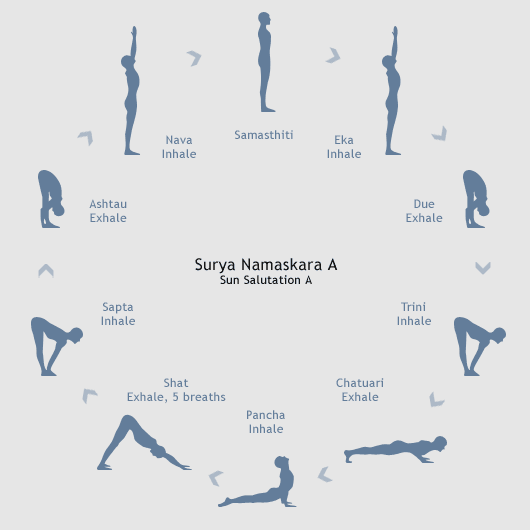 |
Sun Salutation A.
Photo from here.
|
Sun Salutations can be difficult when you are a beginner but there are some tips my amazing teacher has shared with me that have been valuable to me and helped a lot. It’s fun how sometimes just a small tiny modification can make things easier.
As my teacher always says in each and every practice “You must not suffer when practicing Ashtanga. You must feel that your body is working but not too much, you do not want to make your life harder than it already is, you want to make it easier and better. So bring your intelligence in the classroom and modify whatever asana you need to or rest in child’s pose whenever appropriate”.
So here is what he got me through in one of the private lessons I took with him:
First of all a tip for the palms. Whenever your palms are on the floor during the surya namaskara, your hands should be looking straight forward, fingers apart from each other. The thumb should be placed in such a way that exactly at the center of the palm there will be a small gap between your palm and the floor. To understand what I mean place your palms pushing each other like you would push the floor, fingers apart.
Now create a small gap by adjusting your thumb and the area call Mount of Venus. That’s the gap you want to create on the mat. This technique alters the way your body weight is distributed resulting in less strain to the wrists since your forearm muscles work more.
Uttanasana B (Trini): In the beginning of your practice, unless you are really flexible, you will probably not be able place your palms on the ground and this is fine. I use to place my hands either on my shins or on the floor by bending my knees and when I was jumping back I did it all by using my feet. The jumping back should come from controlling the abdominal muscles though and in order to do that you need to have a very strong grounding by your hands (and well, of course, work on your abdominals). So the alternative is this: When you look up keep your legs straight and place your hands further away on the mat, shifting you weight to your upper body, arms and shoulder blades. Then exhale and try to jump back by lifting the legs and keeping the abdominals working. You will realize that this way you upper back, hands and abdominals work a lot more!
Chaturanga Dandasana (chatuari): The trick to stay just above the floor without touching it is carefully (given the fact that you have already practiced for some time and have strengthen your arms, back and leg muscles) is to keep all you body muscles active and pay great attention to the alignment of elbows: they should be close to your body and right above your wrists. The most common mistake (one I did too) is to have them way behind which puts extra strain on the wrists.
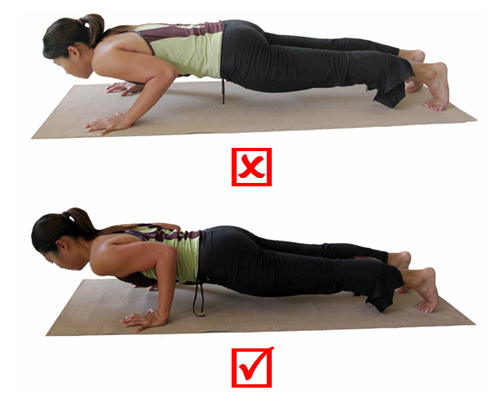 |
Chaturanga Dandasana allignment.
Photo from here.
|
Transition from Upward Facing Dog to Downward Facing Dog: should be always be done by toes roll. I had a very hard time with that and as it appears now, the whole thing was mental. I just thought about it too much and was afraid I would hurt my toes. Well, think of your whole body transitioning not just the toes rolling! It is that simple! Push the floor away with your hands, have your abs engaged and help a bit with your legs (quads) and that’s it.
Transition from Downward Facing Dog to Warrior 1: a nice alternative for my first transitions was to first turn the back foot outwards and then drive the other foot in front in a lunge instead of doing it simultaneously. In my first flows when moving from down dog to warrior I found myself losing balance easily. The turning of the back foot before you enter the warrior provides excellent grounding and the transition is more solid and balanced.
Please notice that this post is not suggesting you should change your routine, or that this is the right way to practice. These were tips I did not do myself at home but were given to me from my teacher on a private lesson (so he might gave different tips to people with different body types) and applied by his guidance and assistance. This post should be regarded as a journal entry addressed to myself. What works for me may not work for you and I will not take responsibility for any possible injury from applying the above mentioned techniques.
">
Twitter
Google
|
Sun Salutation A.
Photo from here.
|
Sun Salutations can be difficult when you are a beginner but there are some tips my amazing teacher has shared with me that have been valuable to me and helped a lot. It’s fun how sometimes just a small tiny modification can make things easier.
As my teacher always says in each and every practice “You must not suffer when practicing Ashtanga. You must feel that your body is working but not too much, you do not want to make your life harder than it already is, you want to make it easier and better. So bring your intelligence in the classroom and modify whatever asana you need to or rest in child’s pose whenever appropriate”.
So here is what he got me through in one of the private lessons I took with him:
First of all a tip for the palms. Whenever your palms are on the floor during the surya namaskara, your hands should be looking straight forward, fingers apart from each other. The thumb should be placed in such a way that exactly at the center of the palm there will be a small gap between your palm and the floor. To understand what I mean place your palms pushing each other like you would push the floor, fingers apart.
Now create a small gap by adjusting your thumb and the area call Mount of Venus. That’s the gap you want to create on the mat. This technique alters the way your body weight is distributed resulting in less strain to the wrists since your forearm muscles work more.
Uttanasana B (Trini): In the beginning of your practice, unless you are really flexible, you will probably not be able place your palms on the ground and this is fine. I use to place my hands either on my shins or on the floor by bending my knees and when I was jumping back I did it all by using my feet. The jumping back should come from controlling the abdominal muscles though and in order to do that you need to have a very strong grounding by your hands (and well, of course, work on your abdominals). So the alternative is this: When you look up keep your legs straight and place your hands further away on the mat, shifting you weight to your upper body, arms and shoulder blades. Then exhale and try to jump back by lifting the legs and keeping the abdominals working. You will realize that this way you upper back, hands and abdominals work a lot more!
Chaturanga Dandasana (chatuari): The trick to stay just above the floor without touching it is carefully (given the fact that you have already practiced for some time and have strengthen your arms, back and leg muscles) is to keep all you body muscles active and pay great attention to the alignment of elbows: they should be close to your body and right above your wrists. The most common mistake (one I did too) is to have them way behind which puts extra strain on the wrists.
|
Chaturanga Dandasana allignment.
Photo from here.
|
Transition from Upward Facing Dog to Downward Facing Dog: should be always be done by toes roll. I had a very hard time with that and as it appears now, the whole thing was mental. I just thought about it too much and was afraid I would hurt my toes. Well, think of your whole body transitioning not just the toes rolling! It is that simple! Push the floor away with your hands, have your abs engaged and help a bit with your legs (quads) and that’s it.
Transition from Downward Facing Dog to Warrior 1: a nice alternative for my first transitions was to first turn the back foot outwards and then drive the other foot in front in a lunge instead of doing it simultaneously. In my first flows when moving from down dog to warrior I found myself losing balance easily. The turning of the back foot before you enter the warrior provides excellent grounding and the transition is more solid and balanced.
Please notice that this post is not suggesting you should change your routine, or that this is the right way to practice. These were tips I did not do myself at home but were given to me from my teacher on a private lesson (so he might gave different tips to people with different body types) and applied by his guidance and assistance. This post should be regarded as a journal entry addressed to myself. What works for me may not work for you and I will not take responsibility for any possible injury from applying the above mentioned techniques.

